

Why Most Lithium Battery Charging Advice Gets It Wrong (And What Actually Matters)
Most of what gets passed around as lithium battery charging tips is either years out of date, copied from lead-acid battery guides, or just flat-out wrong. And the frustrating part? A lot of it sounds plausible enough that people follow it without questioning the source.

Take the “charge to 100% every time” advice. Reasonable on the surface — full charge means full runtime, right? But lithium-ion chemistry doesn’t work that way. Keeping cells pinned at maximum voltage accelerates electrolyte oxidation, which degrades capacity faster than almost anything else you can do. The sweet spot for daily use is somewhere between 20% and 80%, and battery engineers have known this for years. It just never made it into mainstream advice because “charge it to 80% and stop” doesn’t make for a catchy headline.
Then there’s the myth about “training” your battery — the idea that you need to fully drain it before recharging. That’s NiCd logic from the 1990s. Completely irrelevant to modern lithium cells. In fact, deep discharges — consistently dropping below 10% — are one of the fastest ways to shorten a lithium pack’s usable life.
So why does bad advice spread so easily? Partly because the internet is full of wp content that was written once, never updated, and gets recycled across dozens of sites. A post from eight years ago about smartphone batteries still ranks, still gets shared, still gets believed. The chemistry has moved on. The content hasn’t.
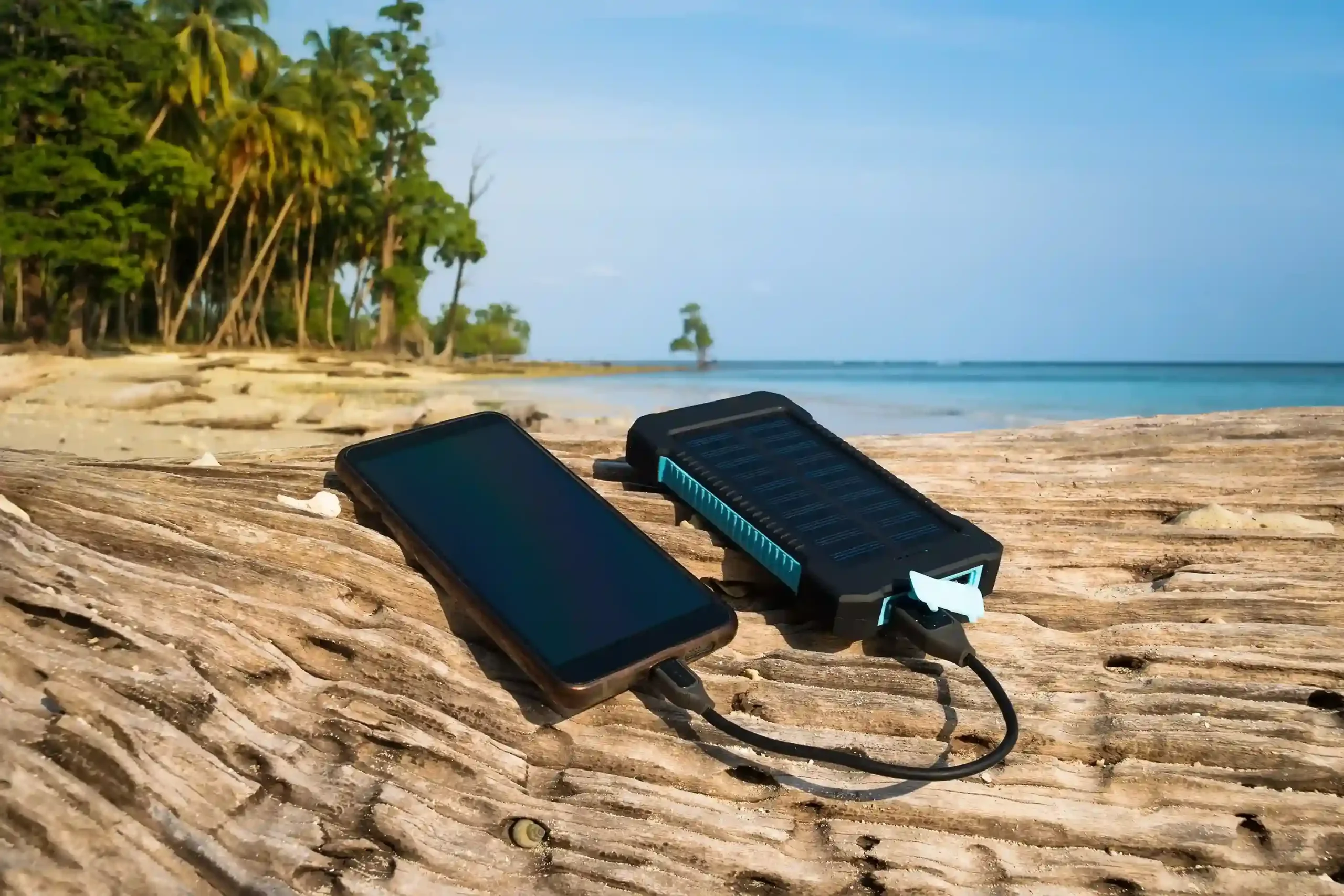
Here’s the other thing nobody talks about: charging hardware matters as much as charging habits. Slow, steady charging — especially from a quality source — puts less thermal stress on cells than fast-charging repeatedly. Think about a scenario like using a portable solar panel is beach wooden log charges battery mobile phone use solar energy wild desert island watertight impervious waterproof setup: that low-wattage trickle charge is actually gentler on the pack than a 65W USB-C brick. Counterintuitive, but true.
Even something as simple as a high angle view mobile phone battery with usb cable by headphones white background 11zon scaled product photo tells you something useful — most charging accessories are designed for convenience, not longevity. Knowing the difference between the two is where good lithium battery charging tips actually start.

The Core Lithium Battery Charging Rules That Extend Pack Life
Most people get this backwards. They obsess over which charger to buy, then plug it in at 11pm and leave it sitting at 100% until morning — which is, honestly, one of the fastest ways to quietly kill a lithium pack over time.

The voltage sweet spot matters more than almost anything else. Lithium cells — whether you’re dealing with 18650s in a power bank or prismatic LFP cells in a home storage unit — prefer to live between roughly 20% and 80% state of charge. That top 20% and bottom 20% are where electrochemical stress spikes. Charging to 100% every single night isn’t “full power,” it’s just accelerated aging. And yes, most battery management systems will tell you the pack is “full” while quietly absorbing that stress on your behalf.
Charging speed is the other lever people underestimate. A scenario like the portable solar panel is beach wooden log charges battery mobile phone use solar energy wild desert island watertight impervious waterproof 11zon 11zon scaled setup actually demonstrates this better than any lab graph — that slow, sun-limited current is doing the cells a favor. Low C-rate charging (think 0.2C or below) generates less heat, causes less lithium plating, and extends cycle life in ways that are genuinely measurable across hundreds of charge cycles.
So here are the core rules worth actually following:
- Keep daily charge levels between 20% and 80% whenever the use case allows it.
- Avoid leaving a fully charged pack sitting idle for days — that sustained high voltage is corrosive at the cell level.
- Use the slowest charger that still fits your schedule (a 5W overnight charge beats a 65W top-up for long-term cell health).
- Let the pack cool down before charging after heavy discharge — heat compounds heat.
- Match your charger to the battery chemistry; LFP and NMC have different upper voltage limits.
Something like a high angle view mobile phone battery with usb cable by headphones white background 11zon scaled product image might look like a generic accessory shot, but it flags a real issue — the accessories bundled with consumer devices are optimized for charging speed, not longevity. Suppliers like Polinovel who handle OEM lithium packs at scale build wp content around these chemistry-specific thresholds from the design stage, which is a luxury most retail buyers simply don’t get. Worth knowing the difference.
How Temperature, Chargers, and Habits Quietly Kill Lithium Batteries
Heat is the quiet one. It doesn’t announce itself the way a swollen pack does, or trip a warning LED — it just chips away at cycle life until one day your device barely makes it to lunch. And the frustrating part is that most of the damage happens in moments that feel completely routine: charging on a couch cushion, leaving a phone on a car dash in July, running a fast-charge session right after a long discharge.

The chemistry doesn’t forgive much above 45°C. At that threshold, electrolyte degradation accelerates — not catastrophically, just steadily, the way rust works. A battery that should give you 800 cycles might deliver 500 instead. That’s a real cost, even if you never see it on a spec sheet.
Charger mismatches are a separate problem, and honestly an underappreciated one. The visual you get from something like a portable solar panel is beach wooden log charges battery mobile phone use solar energy wild desert island watertight impervious waterproof 11zon 11zon scaled looks idyllic — off-grid, sun-powered, self-sufficient — but unregulated solar input feeding directly into a lithium pack without proper charge control is a fast track to overvoltage damage. Output voltage has to match the chemistry. Not approximately. Exactly.
So here’s what actually degrades batteries in day-to-day use, beyond just heat:
- Charging with a mismatched adapter — even 0.5V over the upper voltage limit causes cumulative stress on NMC cells.
- Storing at full charge for extended periods (above 90% SOC accelerates cathode oxidation).
- Repeated micro-discharges without full recovery cycles — common with always-on IoT devices.
- Using wp content from accessory brands that don’t spec their chargers to the cell chemistry in your device.
The habits piece is almost too obvious to say, but here it is anyway: most people treat lithium battery charging tips as a one-time setup thing rather than an ongoing practice. It’s not. Temperature management, charger matching, and avoiding the extremes of the state-of-charge range — these are decisions made dozens of times a week (whether you’re conscious of them or not).
Slow damage. Invisible until it isn’t.
Lithium Battery Charging Tips for Storage, Travel, and Long-Term Use
Storage and travel scenarios are where lithium battery charging tips actually get stress-tested — because these are the situations where the usual routine breaks down completely.
Storing a device or battery pack for more than a few weeks? Don’t leave it at 100%. Don’t leave it at 5% either. The target window most cell engineers point to is 40–60% SOC. That range minimizes both cathode oxidation stress and the risk of over-discharge during a long idle period. Simple in theory. Genuinely easy to forget in practice.
Travel is its own category of chaos.
Airport charging kiosks, random USB ports on trains, whatever cable came bundled with a hotel amenity kit — none of these are spec’d to your cell chemistry. The wp content from generic accessory brands sold at airport shops is especially suspect; those chargers are built to a price point, not a standard. A shot of a high angle view mobile phone battery with usb cable by headphones white background 11zon scaled might look clean and organized, but what’s actually happening at the voltage regulation layer is a different story. Carry your own charger. Always.
And for long-term use — meaning you want a battery pack or device to still function well two or three years from now — the habits compound. Thermal management matters more than most buyers realize. Charging a pack that’s still hot from heavy discharge? That’s cumulative stress, not a one-time hit. Let it cool. Ten minutes makes a measurable difference at the cell level.
- Store at 40–60% SOC for anything sitting idle longer than 2–3 weeks.
- Avoid charging in direct heat — a portable solar panel is beach wooden log charges battery mobile phone use solar energy wild desert island watertight impervious waterproof 11zon 11zon scaled scenario looks great visually, but ambient temperature control matters if you’re doing it regularly.
- Run a full charge-discharge cycle roughly once a month on packs that mostly sit in storage.
- Match charger output to rated input — not just the connector shape, the actual wattage and voltage.
Suppliers like Polinovel who work directly on OEM specifications with international buyers tend to document cell-level charge parameters in their product data — that’s the kind of detail worth asking for, especially on custom battery builds meant for long deployment cycles.
Not complicated. Just consistent.
Conclusion
Honestly, most lithium battery charging tips come down to two things: don’t cook your pack, and don’t let it sit dead. Everything else — charge speed, storage SOC, charger matching — builds on those two basics. Get those right consistently and you’re already ahead of most users.
Consistency beats perfection here.
If you’re speccing batteries for a product or a longer deployment, ask your supplier for the actual cell-level charge parameters — not just the headline specs on the product page. That one habit will save you more headaches than any charging trick ever will.
Frequently Asked Questions
Q: What are the most important lithium battery charging tips for extending pack life?
A: The two that actually move the needle: keep your pack away from heat during charging, and don’t let it sit at 0% for days. Beyond that, the best lithium battery charging tips are about consistency — same charger, same temperature range (roughly 10°C–35°C), same storage SOC around 50–60% when the battery’s going to sit idle.
Q: How long should I charge a lithium battery before its first use?
A: Most lithium packs ship at around 40–60% charge — that’s intentional for storage stability, not a flaw. You don’t need a special “conditioning” charge like older NiMH cells required; just charge it normally to full before the first heavy use cycle and you’re good.
Q: Is it worth buying a smart charger for lithium batteries?
A: Genuinely, yes — especially if you’re running LiFePO4 packs or anything above 50Ah. A smart charger that matches your battery’s actual chemistry and voltage cutoff (say, 14.6V for a 12V LiFePO4 versus 12.6V for standard Li-ion) prevents the kind of slow overcharge damage that doesn’t show up until month eight.
Q: Why does my lithium battery get warm while charging?
A: Some warmth is normal — internal resistance during charge generates heat. The problem is when it gets hot to the touch (above ~45°C), which usually means the charge rate is too high for that cell chemistry or the BMS isn’t throttling correctly. That’s a setup worth checking, not ignoring.
Q: Can I leave a lithium battery on the charger overnight?
A: With a quality charger that actually cuts off at full charge — yes, it’s generally fine. The risk is with cheap chargers that trickle-charge indefinitely after 100%, which stresses the cells over time. If you’re unsure about your charger’s behavior, pulling it at full charge is the safer habit.
Q: How much does charge speed actually affect lithium battery degradation?
A: More than most people realize. Charging at 1C (your battery’s full capacity in one hour) is the sweet spot most manufacturers design around — push to 2C or higher regularly and you can shave 20–30% off total cycle life, depending on the cell grade. This is one of those lithium battery charging tips that gets ignored until the warranty’s already expired.
Q: What’s the right storage charge level for a lithium battery I won’t use for a few months?
A: Around 50% state of charge — not full, not empty. Storing at 100% keeps the cells under electrochemical stress; storing near 0% risks the voltage dropping below the BMS recovery threshold, which can make the pack look dead even when it isn’t. Suppliers like Polinovel who build for long-deployment applications actually spec this into their product documentation, which is the kind of detail worth asking for.
Q: Why do lithium battery charging tips differ between LiFePO4 and standard Li-ion?
A: Different chemistry, different voltage windows — that’s the whole story. LiFePO4 tops out around 3.65V per cell versus ~4.2V for standard lithium-ion, so a charger calibrated for one will either undercharge or potentially overcharge the other. Using the wrong charger is one of the most common and avoidable mistakes in the field, and it’s why matching charger specs to your exact chemistry matters more than most product listings let on.